
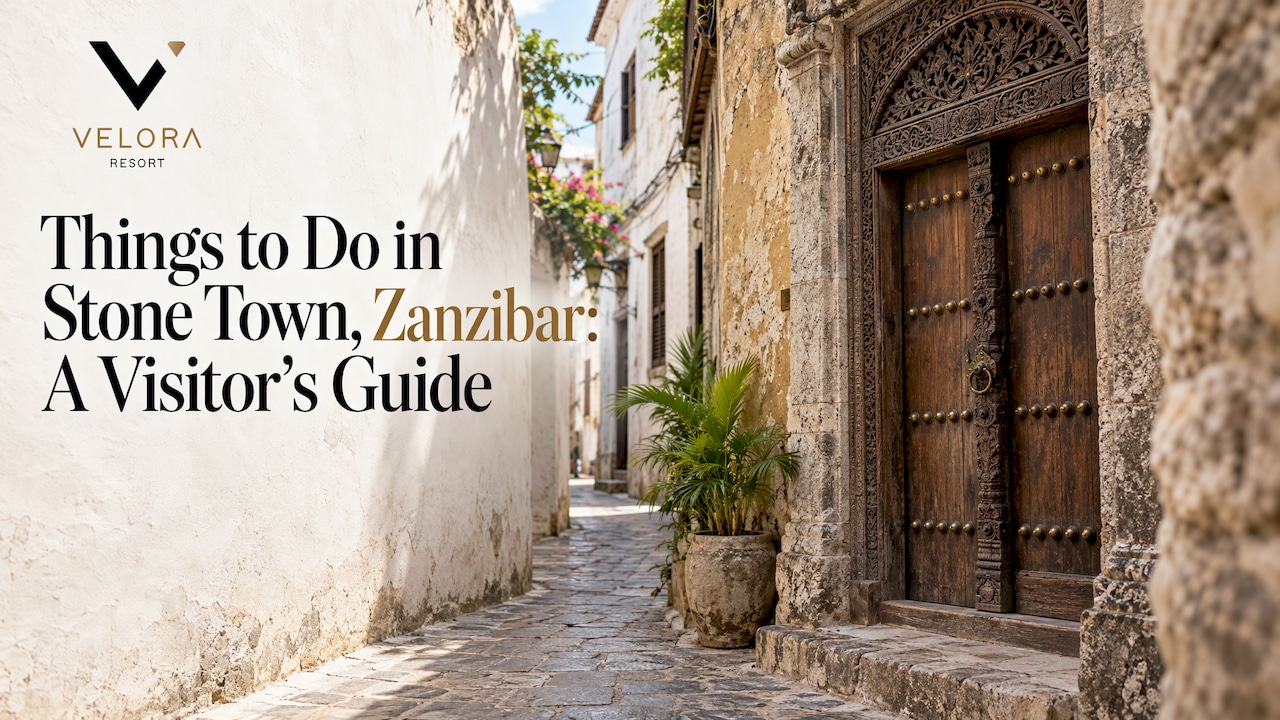
Stone Town rewards a slow half day: carved doors, a former slave market, sultans’ palaces, a covered food market and a seafront garden that fills with grills at sunset. It is also about 90 minutes from Kendwa by road, so the smartest way to see it is as one unhurried day trip from a quiet base on the beach, not as the whole holiday. At Velora Resort in Kendwa we arrange the Stone Town Tour and airport transfers for guests, so you can see the old town and come back to a pool, a balcony and dinner.
TL;DR
- Stone Town is a UNESCO World Heritage Site, and the real attraction is the maze of lanes, carved doors and coral-stone buildings, not one single monument.
- Allow 3 to 4 hours for a focused loop, or a full day if you enter several museums and linger in the back lanes.
- Several landmarks are under restoration, including the Old Fort and the House of Wonders, so you will often see them from outside. Check before you go.
- Dress modestly (shoulders and knees covered), carry small bills and plan to eat at Forodhani Gardens after sunset.
- From Kendwa, count on roughly 1 hour 30 each way by car. We can arrange the tour and the transfer for you.
Table of Contents
- What Stone Town is and why it is worth a day
- The landmarks worth your time
- Walk the streets and read the doors
- Markets, food and the seafront
- A plan for one day
- Etiquette and practical tips
- Getting to Stone Town from Kendwa
- Where to stay: beach quiet after the old town
- Other day trips to pair with Stone Town
- FAQ
- Sources
What Stone Town is and why it is worth a day
Stone Town is the old quarter of Zanzibar City. UNESCO describes it as a Swahili trading town whose buildings and streets have stayed almost intact, shaped by African, Arab, Indian and European influences over more than a thousand years. It was inscribed as a World Heritage Site in 2000, and it is built mostly of coral ragstone and mangrove timber, with narrow winding streets and the famous carved double doors.
In practice that means you do not need a long checklist. Most of what you will remember is the walking: a woodcarver’s workshop, a spice stall, a courtyard mosque you glimpse through an open gate, a door with brass studs. The big sights give the walk a spine, and the lanes give it its character.
The landmarks worth your time
Christ Church and the former slave market
If you do one thing with real weight, do this. The Anglican cathedral stands on the site of the old slave market, and the visit includes a guide and access to the cellars where enslaved people were held. Frommer’s walking tour gives a $5 entry fee including a guide and the cellars beneath nearby St. Monica’s Hostel, while a 2026 local guide lists $10 for the cathedral and market site, guide included, and about 20 minutes for the visit. Prices move, so carry both amounts in small bills and expect the higher one.
The visit is short and sobering. Many travelers prefer to do it early, before the heat and the crowds, and then walk on.
Palace Museum and the House of Wonders
The House of Wonders (Beit al-Ajaib) was built in 1883. It was the first building in Zanzibar with electricity and the first in East Africa with a lift, according to a landmarks list for Stone Town. The building partially collapsed in December 2020, has been shut since, and is being rebuilt. For now you can look at it from the outside and from Forodhani, and it still earns the stop.
The Palace Museum, the former sultan’s residence, is a better place to go inside. Frommer’s lists both it and the House of Wonders as open daily 9am to 6pm with a $3 entrance in its guide, so confirm the current hours and fee when you arrive.
The Old Fort
The Old Fort (Ngome Kongwe) is an Omani fort built around 1700 on the ruins of a Portuguese church. A 2026 local guide reports it has been closed for restoration since January 2026, with its craft stalls, café and amphitheatre moved out and no reopening date announced. The walls are still visible from Mizingani Road, and the fort still anchors the seafront walk.
The Old Dispensary, Hamamni Baths and the mosques
The Old Dispensary was built between 1887 and 1894 by wealthy local Indians as a charity hospital and later restored by the Aga Khan Trust for Culture. Its carved balconies are among the best photo stops on the seafront. The Hamamni Persian Baths date from 1870 to 1888, built for Sultan Barghash bin Said by Shirazi architects, and served as public baths until 1920 but are no longer operational. The Malindi Mosque has a cone-shaped minaret that only two other East African mosques share. Most mosques are closed to non-Muslim visitors, so admire them from the street.
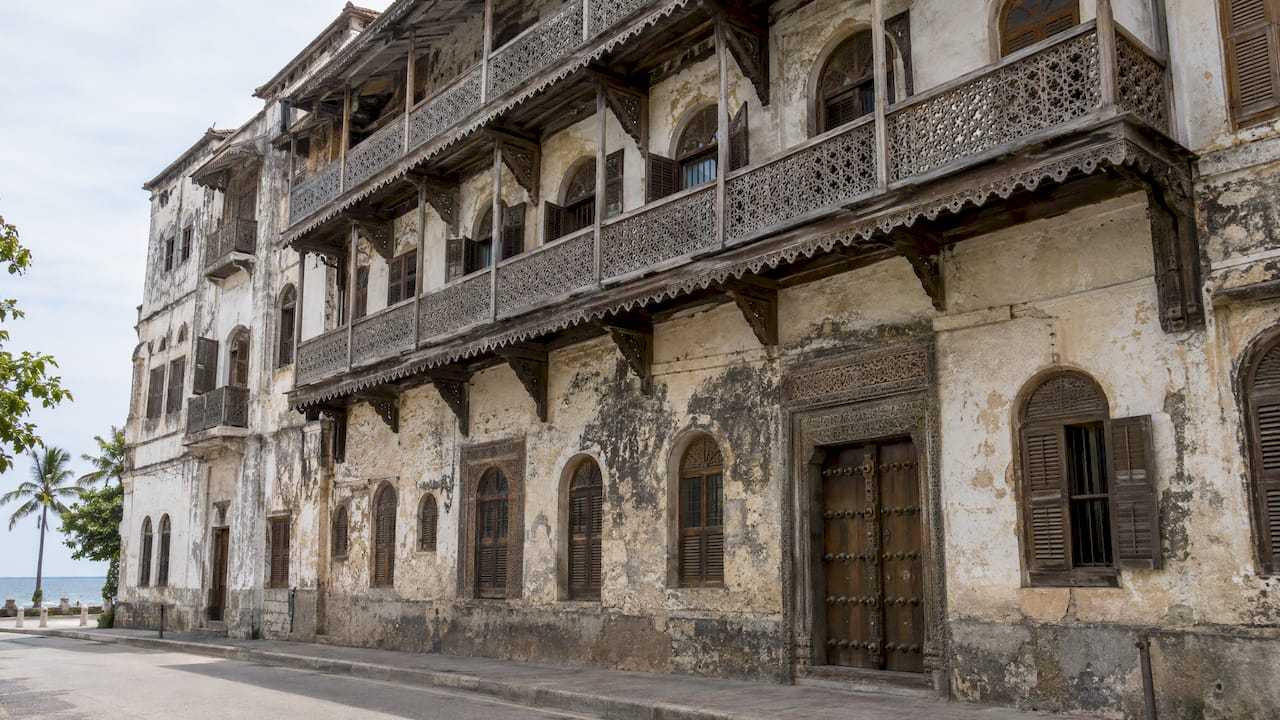
Tippu Tip’s residence is on UNESCO’s list of major buildings, but it is not open to the public, so treat it as a door to look at, not a stop to plan around.
Freddie Mercury Museum
Farrokh Bulsara, later Freddie Mercury, was born in Zanzibar in 1946. The museum’s own page gives its address as Mercury House on Shangani Street, open daily from 9:00 AM to 8:00 PM, with admission of $8 for adults and $6 for children under 12. It is small, so 30 to 45 minutes is enough. It suits families with older children and anyone who wants a break from the sun.
Walk the streets and read the doors
The carved doors are Stone Town’s signature. UNESCO specifically names the carved double “Zanzibar” doors as part of what makes the town exceptional. A local guide adds a useful key: brass studs came from India, heavy geometric lintels from Oman, and fish and chain motifs are Swahili. Once you know that, every lane becomes a small puzzle.
A good pattern for the walk:
- Start early. Between about 7am and 10am the alleys are cool and quiet, and the light is good for photos.
- Begin at the seafront near the Old Fort, then turn into the Hurumzi and Kiponda lanes.
- Keep going toward Gizenga Street and Kenyatta Road for some of the finest carved doors.
- Do not follow a straight line. Getting a little lost is the point, and the old town is small enough that you will always find your way back.
A car cannot fit through most lanes, and local guidance says everything inside the old town is within about a 15-minute walk. Street lighting inside the old town can be patchy, so after dark stick to the main routes.
Markets, food and the seafront
Darajani Market
Darajani is the island’s main food market, in a gable-fronted building from 1904, with separate meat and fish halls and traders selling fruit, vegetables, spices and grains. Frommer’s notes it runs from 8am to 6pm, quieter from 2pm, with morning fish auctions and antique dealers on Wednesdays and Saturdays. Go in the morning, when it is busiest and most interesting, and keep your bag in front of you in the crowd.
Forodhani Gardens at sunset
Forodhani is a small park along the seawalk in front of the Old Fort and the House of Wonders. It was restored by the Aga Khan Trust for Culture and, according to Wikivoyage, hosts a tourist-oriented market selling grilled seafood and other Zanzibari food every evening after sunset. A local guide says it is free to enter, with about $5 enough for food. Go as the light fades, share a few skewers and watch the pier.
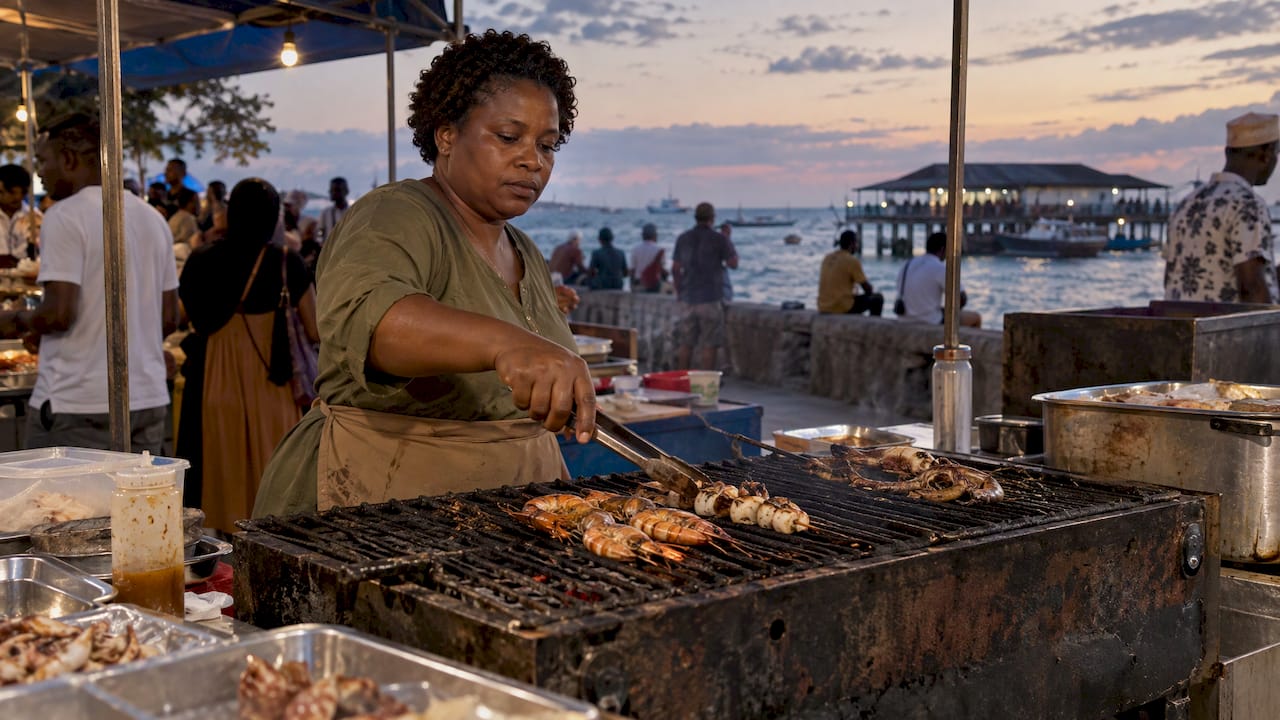
This is also the town’s real evening scene. Stone Town has rooftop bars and waterfront cafés, but no large club culture, which is part of why many couples return to the beach for the night.
Shopping
Look for kangas (printed cotton wraps), spices, carvings and jewelry. Bargain politely, smile and carry small notes. Spices are best bought in a market stall, not from someone who approaches you in the street.
A plan for one day
| Time | What to do | Why |
|---|---|---|
| 7:30 to 9:00 | Doors-and-balconies walk through Hurumzi, Kiponda, Gizenga | Cool, quiet, best light |
| 9:00 to 10:30 | Christ Church and the former slave market | Strongest history, short visit |
| 10:30 to 11:30 | Darajani Market | Busiest and most colorful in the morning |
| 11:30 to 13:00 | Palace Museum or Freddie Mercury Museum, then lunch | Out of the midday heat |
| 13:00 to 15:00 | Back lanes, shopping, a rest in a shaded café | Slow pace, no ticking boxes |
| 17:30 to 19:30 | Seafront, Old Dispensary, then Forodhani at sunset | Food, light and the pier |
A tighter loop of the fort, doors and cathedral can be done in about two hours, but you will mostly be seeing outsides. A focused route including the fort, cathedral, slave market memorial and carved-door streets takes around 3 to 4 hours at a comfortable pace, or a full day if you enter several sites.
Etiquette and practical tips
- Dress. Zanzibar is predominantly Muslim. Cover shoulders and legs below the knee in town. Beachwear belongs on the beach.
- Ramadan. Many restaurants close and daytime streets are subdued. Avoid eating, drinking or smoking in the street in daylight.
- Greetings. Start with a friendly “jambo”, and use “shikamoo” for an older person.
- Touts. Street touts, known locally as papaasi, may offer tours or shops. A polite no is enough, and it is simpler to book through your hotel.
- Pickpockets. Narrow alleys and markets are the places to keep valuables close.
- Cash. Carry small US dollar bills and shillings for entry fees, snacks and tips.
- Photos. Ask before photographing people.
Getting to Stone Town from Kendwa
A 2026 local guide lists taxi fares to Stone Town of $50 to $60 from Nungwi or Kendwa, about 1 hour 30 minutes. That is a good reason to treat it as a single full-day outing. Leave early, spend the day on foot and return after Forodhani, or come back in the late afternoon if you have children.
If you want the day organized, our concierge can arrange our Stone Town Tour at 30 to 70 EUR per person, with the price depending on the option you choose. We also offer an airport transfer at 50 USD for arrival and departure days, so your first and last day on the island start without haggling.
Where to stay: beach quiet after the old town
Stone Town is fascinating, but it is crowded, hot and loud by midafternoon. Kendwa gives you the opposite: a long beach, a swimming pool and a terrace to come back to. Velora is a small boutique retreat steps from Kendwa Beach, with air-conditioned rooms and private balconies, plus wellness treatments and massages for tired feet after a day on cobbles.
Our Deluxe Queen Room, Triple Room and Deluxe Triple Room suit couples, families and small groups. For a quieter evening after the town, our Dinner on Demand lets you eat privately instead of heading out again.

If you are still deciding on a beach, our guide to Kendwa or Nungwi compares the two. Couples planning the whole trip can read our honeymoon guide to Zanzibar, and our excursions and prices section shows how a Stone Town day fits next to other outings.
Other day trips to pair with Stone Town
Stone Town fits well beside other outings, since they are all arranged by the same concierge desk. A Spice Tour (15 to 60 EUR per person) fits the island’s spice-trading history. The Nakupenda excursion (40 to 80 EUR per person) gives you a sea day after a land day. For something different, the Visit of the South is 60 to 140 EUR per person, and Authentic Zanzibar is 45 to 110 EUR per person. The full list is on our excursions page.
FAQ
What is Stone Town known for?
It is known for its historic old quarter, which UNESCO inscribed in 2000. It was a center of the spice and Indian Ocean trades and of the slave trade, and it is famous for its coral-stone buildings, narrow lanes and carved doors. It was also the birthplace of Freddie Mercury.
How long do you need in Stone Town?
A focused walk takes 3 to 4 hours, and a full day lets you enter several sites and linger in the back lanes. From Kendwa, a day trip works well because the drive is about 1 hour 30 each way.
Is there nightlife in Stone Town?
The main evening activity is Forodhani Gardens, where food stalls set up after sunset. There are also rooftop bars and waterfront cafés. It is more relaxed than a club scene, so many visitors finish the day there and head back to the beach.
What should I wear in Stone Town?
Cover your shoulders and your legs below the knee. Light long trousers, a loose dress or a skirt, and a light shirt work in the heat. Keep swimwear for the beach and the pool.
Sources
- Stone Town of Zanzibar, UNESCO World Heritage Centre
- Walking Tours in Stone Town, Frommer’s
- Plan Your Visit, Freddie Mercury Museum
- List of landmarks in Stone Town
- Stone Town Zanzibar: what to see, costs and timings
- Stone Town, Wikivoyage
- Stone Town Walking Guide, Nomado Travel